Make It Make Cents
- Best for
- Projected or independent bell ringers
- Format
- Daily individual, pair, or whole-class challenge
- Time
- 5–10 minutes
- Accounts
- No student or teacher accounts
- Devices
- One projected screen or a device per student or pair
Choose a rotating financial puzzle, a live class debate, or a five-question vocabulary challenge that gets students thinking before the lesson begins.
Choose a gameEach product is designed to run in a browser without named student accounts. Make It Make Cents, Finance Faceoff, and Missing Cents are currently free and publicly available.
| Game | Best for | Format | Typical time | Student accounts | Devices |
|---|---|---|---|---|---|
| Make It Make Cents | Projected or independent bell ringers | Daily individual, pair, or whole-class challenge | 5–10 minutes | None | One projected screen or a device per student or pair |
| Finance Faceoff | Whole-class choice and discussion | Teacher-hosted live poll | 5–10 minutes | None | Teacher display plus an internet-connected device per student or pair |
| Missing Cents | Vocabulary checks and quick review | Individual or projected five-question challenge | 3–5 minutes | None | One projected screen or a browser-enabled device per student |

Use a new short challenge each weekday to activate vocabulary and financial reasoning before the lesson.
Students solve the day’s vocabulary challenge, complete a financial scenario, or connect related money terms.
Open the daily challenge in a browser, then project it for a shared solve or have students work independently or in pairs.
A quick opening routine when you want students retrieving language, reading a realistic scenario, or explaining how ideas connect.
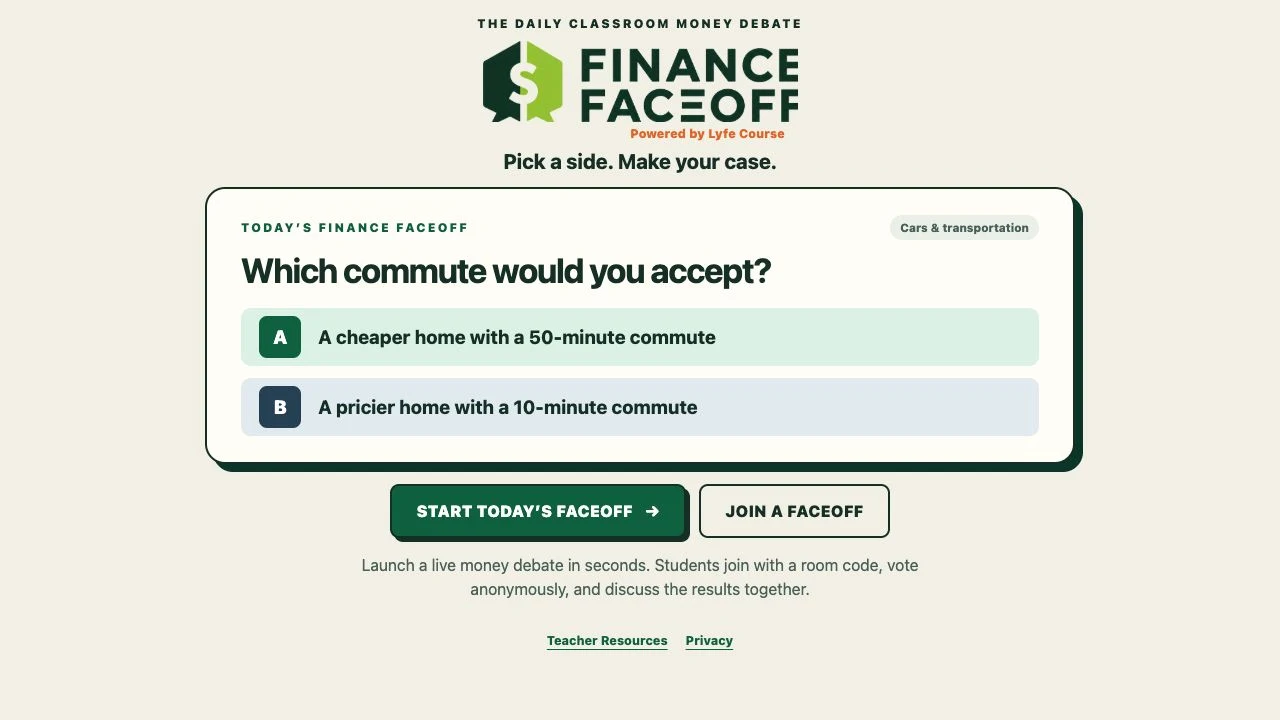
Launch a live A-or-B financial decision, collect anonymous votes, and use the results to start a class debate.
Students join with a six-digit room code, choose between two financial options anonymously, and explain their reasoning.
Start the weekday faceoff, share the room code, reveal the class result, and use the provided prompts to lead the discussion.
A fast way to compare competing priorities, discuss tradeoffs, and give every student a low-stakes way to choose a position.
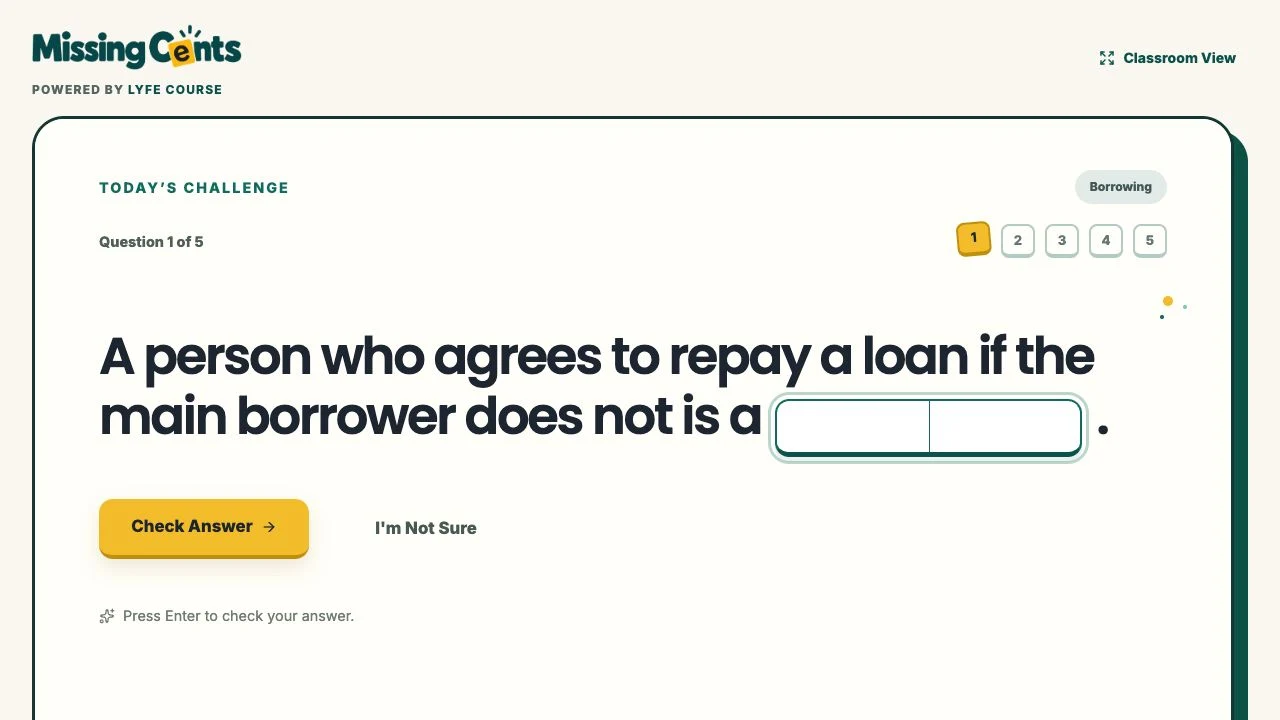
Give students a compact set of financial fill-ins with hints and explanations, either independently or on a shared screen.
Students complete five financial sentences, use optional hints, and review an explanation after each response.
Choose the daily challenge or practice mode, then let students work on their own devices or use Classroom View for a shared solve.
A brief vocabulary check when students need to connect a financial term to the meaning it carries in context.
The strongest follow-up is brief: make students name the evidence, then test whether their reasoning changes when the facts change.